
Phoenix Link
General Tso, Confucius Say, Queen Chiu, Sensei Master

Similar Games:
Buffalo Link and Lightning Buffalo Link
Risk Scale:
Red (could be lower if you find a great number, but you could still lose 300 bets on the extreme high end)
Minimum Play:
Similar to Buffalo Link and Lightning Buffalo Link, but instead of 1,340 as the recommended number, play any 1,550 or higher.
Other:
My 1,550 figure is admittedly conservative.
I should say this right off the bat: Like with Buffalo Link, some pros will play Phoenix Link lower (around 1,400) than my recommendation, especially if comps are a factor. The number 1,550 is conservative and doesn’t factor in what your casino’s RTP might be.
But with a game this volatile, both in how long it takes to reach the feature you’re chasing and what that feature ultimately pays, I tend to tighten up. A little backstory: I’ve had three primo finds on $50 bets on big denominations—which many folks think matters for a game like this—and each one was a disaster.
Here’s something no one with a bankroll would turn down:
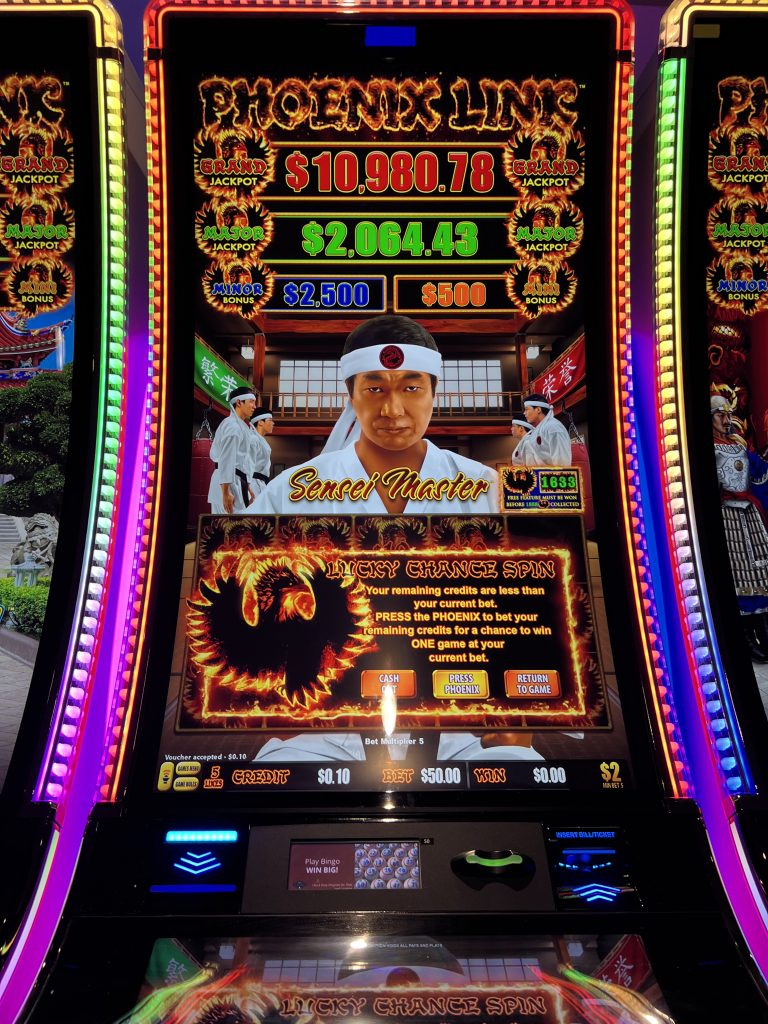
That’s a 1,633 on a $50 bet on the $2 denom (i.e., a monster bet and find). The result? I split it with some friends, which you can see in one of my videos at the end, and we lost close to $10,000. That’s around 200x the bet on a 1,633.
Want another? Maybe Sensei Master just hated me:
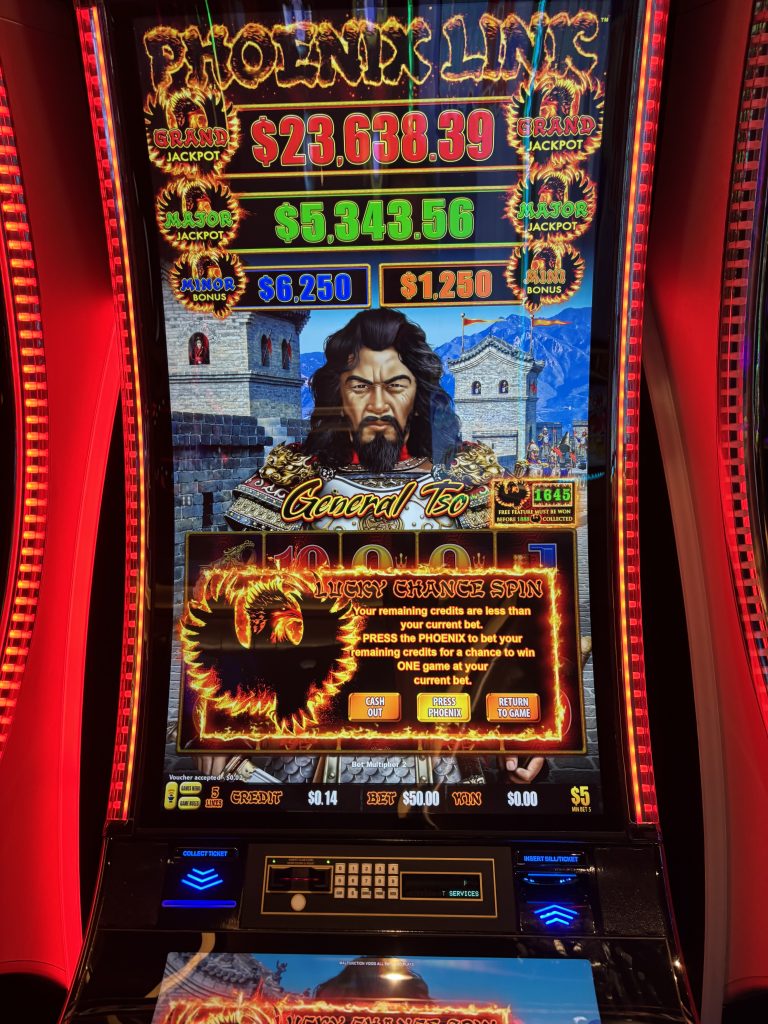
Well, General Tso must hate me too.
This was another loser on a $50 bet on a $5 denom. Yes, a sampling of three or four huge bets on this sort of game is not nearly enough to write it off completely. But because the game is now everywhere across the country and beyond, it is not uncommon to stumble upon some massive bets. If you get squeamish at the thought of losing piles of money, I’d recommend not even bothering to check this game.
But if you do want to check it?
You may have noticed that both photos above have a “lucky chance spin” shown on the screen. That’s not a coincidence. Here’s this from my Buffalo Link section, where I tweaked the wording in a few spots for this entry:
With [Phoenix] Link, you can’t check each denom and bet without putting your voucher in. But wait a second. Once you put your voucher in and check a different bet, it automatically spins and costs you money.
What do you do? Well, you can put in a voucher of $0.99 or lower and click through each bet to see if you can find a [1,550] or higher. The game will ask you the following:
Want to cash out your [$0.14], press [phoenix], or return to the game? Cashing out is just cashing out. Hitting “press [phoenix]” will give you a fractional chance of getting one spin. So if it’s a $1 bet and you “press [phoenix]” with a [$0.14] voucher, you should have a [14%] chance to get one spin. But for our purposes, we want to hit “return to game.”
That will usually let us check the various bets on every denom without risking anything. I say “usually,” because sometimes the game glitches and doesn’t even let us do that, making a tedious process all the more frustrating.
Phoenix Link may look like Buffalo Link and Buffalo Lightning Link, and there are some clear similarities. There’s a must-hit feature in the top right corner of the reels, and in this case, that number can’t exceed 1,888. That’s different from Buffalo Link and Buffalo Lightning Link, where those numbers can’t exceed 1,800. It might not sound like much, but in an already-volatile game, it makes a difference.
Secondly, the number doesn’t reset to 100 after being triggered, as it does on the originals. Instead, it resets to a random number. That also may not sound like a big deal, but it is when you’re trying to find advantage plays.
Because it doesn’t reset to 100 every time and can instead theoretically reset to something much more favorable after triggering, that decreases the strength of a number like 1,340, which is my go-to number in the originals.
Like with both, the number increases as you collect buffalo heads/phoenix symbols. You’ll often spin a couple or so on average per turn, but that number feels like it’s crawling up, especially if you don’t get lucky and back into any random bonuses on the way.
Landing three or more bonus symbols gives you free games, and the theme changes depending on what version of Phoenix Link you’re playing. This bonus can pay you literally $0 or hundreds and hundreds of times your bet, with plenty of options in between.
The other bonus is achieved by hitting eight or more phoenix symbols. They have various amounts of money imprinted on them, with most being just 1x or 2x your bet. So if you’re betting $5, you’ll see a lot of $5 and $10 phoenix in this bonus. This bonus never pays $0 like the free games bonus sometimes can, but it’s also often underwhelming. Of course, every blue moon, you’ll hit some 200x or 300x phoenix.
You’re hoping to hit some of these random bonuses before you trigger the must-hit bonus, which can happen at any point on the way to 1,888. If you play Phoenix Link, bring your wallet and hope for the best. Losing 250 or so bets is possible, even on 1,550-type numbers. I’ve done that plenty.
A couple of extras that I find interesting:
- I’ve heard that some casino reps, well aware of advantage play machines and trying to limit their appearances in their casino, fully embrace Phoenix Link’s arrival. They believe the advantage is so minuscule that they don’t mind when pros seek the machines out.
- However, some pros seek out brand-new installs of Phoenix Link. Why? They wholeheartedly believe that new installations can be taken with lower minimum play thresholds and also pay out well above average, especially on bigger denoms. There may be some validity to this, as some new installs do come frontloaded with payouts (a game such as Power Push comes to mind immediately).
The cat-and-mouse game continues!
Here are some videos of Phoenix Link in action: